Hany Awadalla · awadalla.ai · March 8, 2026 · 12 min read
TLDR — Read This Even If You Skip Everything Else
In March 2026, Anthropic published the most granular real-world study yet of AI's labor market impact. Computer programmers: 75% of their tasks now covered by AI. Hiring of young adults (22–25) into exposed professions: already down 14% since ChatGPT launched — before any unemployment spike is visible.
Egypt is not in that study. But its implications land here with a specific force that the global headlines miss entirely.
The core finding, in one sentence: Egypt faces roughly the same automation exposure as the West, but with three structural amplifiers — a youth employment crisis, an education system training people for the wrong jobs, and a remittance economy built on diaspora work that Gulf AI strategies are also disrupting — that make the downside steeper and the timeline more compressed.
The upside: a 3–5 year deployment gap between what AI can do and what it is actually doing in Egypt today. That is a window. The question is whether it gets used deliberately or wasted — as was done with the internet.
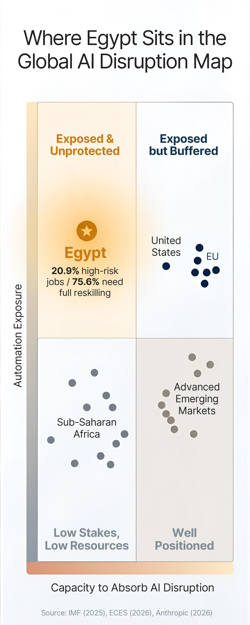
Figure 1 — Egypt's position in the global AI disruption map. Sources: IMF (2025), ECES / Dawoud et al. (2026), Anthropic / Massenkoff & McCrory (2026)
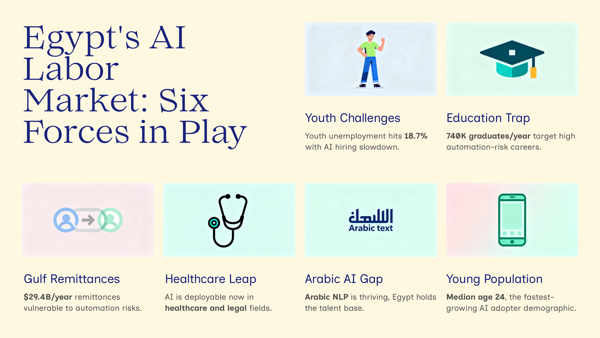
Figure 2 — Egypt's six AI labor forces. Sources: ECES (2026), Anthropic (2026), Egypt CAPMAS, World Bank
The Data That Started This
In March 2026, Anthropic published Labor Market Impacts of AI: A New Measure and Early Evidence — the most rigorous attempt yet to separate what AI theoretically can do from what it is actually doing in the economy. The gap is striking: for Computer and Mathematical occupations, 94% of tasks are theoretically AI-feasible. Observed real-world coverage on Claude's platform: 33%.
I read that report the week it came out. I have spent years working at the frontier of language AI — building the models, running the research, watching the capability curves climb. I was also educated in Egypt. I did my early studies there, learned to think there, watched an entire generation of talented people build careers in exactly the roles the Anthropic report flags as most at risk.
The report is a US study. Its data is US data. But the underlying technology does not respect borders, and the displacement pressure it documents is already traveling. The question I keep returning to is not whether Egypt will feel this — it will — but how it will feel it, and whether the people making decisions right now understand that Egypt's version of this story is not just a smaller version of America's.
It is a structurally different story. With different stakes, different timing, and — if we are honest about it — a specific set of advantages that only exist if they are seized in the next few years.
What the Anthropic Report Actually Shows
Three findings from the report deserve careful attention before applying any of them to Egypt.
First: the most exposed workers are not who most people assume. In the US, workers in the top quartile of AI exposure are more likely to be female, more educated, and earn 47% more than their less-exposed counterparts. This is not the story of robots replacing factory workers. It is the story of language AI replacing the cognitive, communicative, and administrative work that forms the backbone of white-collar employment — financial analysis, customer service, data entry, document processing, coding.
Second: the actual damage is slow-building, not sudden. There is no unemployment spike in the data yet. What there is — and this is the signal worth watching — is a 14% drop in new job starts for workers aged 22–25 entering AI-exposed occupations. The jobs aren't disappearing. The doors are quietly closing to new entrants. This is how structural displacement begins: not with layoffs, but with hiring freezes.
Third: the gap between capability and deployment is large but narrowing. Today, AI covers a fraction of what it theoretically could. That gap is the policy window. When it closes — and it will close, as it already has in coding and customer service — the adjustment pressure arrives much faster than the preparation.
Egypt's Risk Profile Is Not the Same as the West's
The Egyptian Center for Economic Studies recently published the most comprehensive AI labor risk analysis ever conducted for Egypt — a validated knowledge graph of 9,978 Egyptian job postings, mapping 84,346 job-skill relationships across the formal economy.
Their headline finding: 20.9% of Egyptian formal-sector jobs face high automation risk — roles where more than 60% of core tasks are AI-feasible. Clerical Support Workers face the steepest exposure at 54.6% average risk, with nearly half already in the high-risk category. Professionals, who make up 44% of the formal dataset, average 40.4%.
These numbers are comparable to Western estimates. What is not comparable is what happens after the risk materializes.
In the US and Europe, workers at risk have access to retraining ecosystems — community colleges, bootcamps, government-funded upskilling programs, portable labor rights. The ECES study asked a harder question: how many at-risk Egyptian workers actually have a realistic pathway to a safer job?
The answer: 24.4%.
The remaining 75.6% — over three in four at-risk workers — have no organic transition pathway. They need full reskilling, not incremental upskilling. There is no pathway that closes this gap passively. It requires deliberate, funded, targeted intervention — and that intervention does not yet exist in any serious form.
Amplifier 1 — The Youth Double Compression
Egypt's youth unemployment rate sits at 18.7% for workers aged 15–24. That number is not new — it has been structurally elevated for years, driven by a skills mismatch between what universities produce and what the economy needs.
Now overlay the Anthropic finding: hiring into AI-exposed occupations for 22–25 year olds has already slowed by approximately 14% in the United States. The jobs young Egyptians have historically targeted as their first professional foothold — administrative roles, financial analysis, data processing, customer service — are precisely the roles being deprioritized by firms globally as AI tools absorb more of the task load.
Egypt's youth bulge is not a future projection. It is happening now. Median age: 24.3 years. More than 42% of the population is under 25. This is the largest cohort of labor market entrants in Egypt's history entering a job market where the doors to entry-level white-collar work are quietly, systematically narrowing.
The interaction effect is what matters. Youth unemployment at 18.7% is already a crisis. Add an AI-driven hiring slowdown in exactly the job categories that represent the traditional path out of that crisis, and you have a compression that cannot be addressed by any single policy.
Amplifier 2 — The Education Trap
Egypt produces approximately 740,000 university graduates per year. Roughly 28% study STEM fields. This is, on its face, encouraging — a large, educated young population with technical training.
The problem is where that STEM pipeline flows.
Egypt's university system has historically calibrated its graduates toward financial analysis, accounting, data management, administrative coordination, and clerical processing — the roles that require technical literacy but not deep technical creativity. These are the same roles that the ECES study places at 51–62% average automation risk. The highest-risk job categories in Egypt's formal economy overlap almost exactly with the occupations that absorb the largest share of Egypt's graduates.
This means Egypt may be making its most dangerous AI-era investment in slow motion, one university enrollment at a time. Students choosing accounting degrees, business administration, and data management are choosing with the information available to them — these have been reliable, respectable career paths. That information is now outdated, and they are not being told.
The urgency here is asymmetric. A student who enters university today and graduates in four years will enter the job market in 2030 — at the far edge of the 3–5 year window. The curriculum redesign needs to begin this academic year, not the next one.
Amplifier 3 — Remittances Under Gulf AI Pressure
Egypt received $29.4 billion in remittances in 2024. That represents 7.6% of GDP — a figure that dwarfs foreign direct investment and rivals tourism as an economic pillar. Over six million Egyptians live and work abroad, the majority in Gulf Cooperation Council countries: Saudi Arabia, the UAE, Kuwait, Qatar.
What do those six million people do? Predominantly: administrative and clerical work, services coordination, financial processing, logistics management — occupations in the medium-to-high automation exposure range.
Here is the dimension that almost no economic analysis of Egypt has modeled: Saudi Vision 2030 and the UAE AI Strategy 2031 are among the most aggressively funded AI transformation programs in the world. The Gulf states are not passively adopting AI — they are building sovereign AI infrastructure, replacing administrative functions with automated systems, and actively restructuring the labor categories that have historically absorbed Egyptian diaspora workers.
Egypt's remittance income is downstream of AI adoption decisions being made in Riyadh and Abu Dhabi. The double exposure — domestic job market automation and diaspora income compression — is a specific vulnerability that Egypt shares with very few other economies and that global AI labor research has not begun to address.
Three Windows That Only Egypt Can Open
None of the above forecloses the possibility of a different outcome. Three structural advantages are real — but they are time-sensitive.
Window 1: The regulatory leapfrog in healthcare and legal services.
Egypt's AI regulatory framework is still in draft form — a risk-based approach modeled loosely on the EU AI Act, but lighter in enforcement. The EU AI Act, now fully enacted, creates multi-year approval timelines for AI applications in high-stakes domains like healthcare diagnostics and legal document processing. Egypt has no equivalent friction today.
Egypt also has a severe healthcare provider shortage. AI-assisted diagnostic triage tools that would require years of regulatory approval in Germany or France could be deployed in Egyptian healthcare settings now — serving a population that has no alternative at equivalent quality. The same logic applies to legal services: AI contract analysis and document drafting could dramatically expand access to legal counsel for the majority of Egyptians who currently have almost none.
Window 2: Arabic AI is still first-mover territory.
The dominant AI models and applications are English-first. Arabic is structurally underserved in training data, fine-tuning, alignment research, and application development. Egypt is the Arab world's most populous country, with a large STEM graduate base, an established tech ecosystem (600+ startups, $6.5B ICT sector), and multinationals expanding Cairo operations.
There is early evidence this can be done smartly. In February 2026, Egypt's Ministry of Communications launched Karnak (كرنك) — a national Arabic LLM built by the Applied Innovation Center. Crucially, it was not built from scratch. Karnak is depth-extended from Alibaba's open-source Qwen3, with a custom Arabic tokenizer and continued pre-training on high-quality Arabic data. It currently ranks at the top of the Open Arabic LLM Leaderboard in its parameter class. The model's first applications target exactly the right problems: an AI tutor for Arabic language and Egyptian history, a legal assistant to help citizens navigate regulations, and medical screening tools for underserved communities.
The lesson in Karnak's architecture is as important as the model itself. Egypt did not need to spend billions competing with OpenAI or Google. It needed to take the best available open-source foundation, adapt it with precision for the Arabic context, and deploy it where the need is greatest. That is a replicable playbook — for government, for startups, for universities.
Window 3: Young, mobile-native, and not yet locked in.
Egypt's median age of 24.3 means its dominant workforce cohort has none of the mid-career lock-in that makes technology adoption slow in the West. They are mobile-first (96% of internet access is mobile), socially networked, and — as the NBER ChatGPT usage study shows — faster-growing as AI adopters than their counterparts in higher-income countries.
A young population that adopts AI tools fluently, at scale, early, becomes a workforce that is augmented rather than displaced by them — provided the tools they are adopting are relevant to productive work. That distinction is an education and policy design question, not a technology question.
The Window and What Needs to Happen
The Anthropic report documents a large gap between theoretical AI capability and actual deployment. For Egypt, that gap is even wider — only 9.8% of Egyptian internet users currently use any AI tool regularly. That gap is the 3–5 year window. It narrows every quarter. But it is real, and it is actionable.
For policymakers: The single highest-leverage investment is a national bridge skills program targeting the specific competencies the ECES study identifies — process improvement, operations coordination, project management, quality engineering — not generic "digital literacy." The 25 high-leverage bridge skills identified in the Egyptian skills graph are specific, teachable, and lead to occupations with low automation risk.
For university and academic leaders: The curriculum recalibration cannot wait for a policy mandate. Every faculty that today directs students primarily toward data entry, routine financial processing, and administrative coordination roles is doing those students a disservice with every enrollment cycle. The honest conversation about which career paths are contracting needs to happen inside Egyptian universities now, with the data on the table.
A note on what works — and what doesn't: Countries that have navigated this well offer a clear lesson. Finland trained 10% of its entire population in AI basics through a free, online course built with the private sector — at negligible cost compared to enterprise retraining programs. Singapore's SkillsFuture program delivered 555,000 learners in 2024 through short, sector-specific courses co-designed with employers, with AI course enrollments jumping 182% in a single year. The common thread is specificity and employer involvement. The cautionary evidence is equally clear: a Harvard study published in 2025 found that workers retrained into high-AI-exposure occupations earned 25–29% less than those retrained into lower-exposure fields. The direction of retraining matters as much as the fact of it. Egypt does not need a generic "digital skills" campaign — it needs a targeted, employer-anchored program pointed at the specific bridge skills the data identifies as both in-demand and automation-resistant.
For business and technology leaders: The 3–5 year window is also a talent market window. The engineers, product managers, and researchers who will build Arabic-language AI applications are sitting in Egyptian universities and early-career roles today. The companies that invest in that talent — treating Egypt as a builder rather than just a deployment market — will have a structural advantage when the Arabic AI gap becomes a global priority, as it will.
A Final Word
I have spent years inside the organizations building this technology. I know what it can do and — just as importantly — how fast the remaining gaps are closing. I am not writing this to generate alarm. Alarm without specificity is useless.
I am writing this because the data is now detailed enough to act on, and the gap between what the global AI conversation addresses and what Egypt specifically needs to understand is large enough that it felt like a responsibility to try to close it.
Whether Egypt ends up closer to the risk scenario or the opportunity scenario in 2030 will not be decided by the technology. It will be decided by whether the people in this country who understand both worlds — the technology and the ground reality — make enough noise, clearly enough, soon enough.
What are you seeing on the ground? Are the risks I've outlined landing with the urgency they deserve in the institutions you work in — or is the narrative still "this is a problem for later"? I'd particularly value perspectives from people working in Egyptian higher education, workforce development, and technology policy.
Sources: Massenkoff & McCrory (2026), Anthropic — Labor Market Impacts of AI; Dawoud et al. (2025/2026), Egyptian Center for Economic Studies — Graph-Based Analysis of AI-Driven Labor Market Transitions; Chatterji, Deming et al. (2025), NBER — How People Use ChatGPT; IMF World Economic Outlook (2025); World Bank; Egypt CAPMAS.
Tags: AI · Egypt · Jobs · Future of Work · MENA · AI Leadership · Labor Market